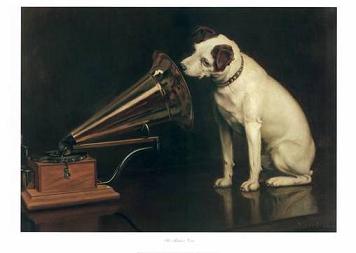
His master's voice (c) Francis Barraud
does this look familiar? ever heard of a "gramophone" or a "phonograph"? i've always wondered if the dog in the painting was real. apparently yes, and its name was "nipper." i'm posting barraud's painting in honour of the new orleanders' pets that were left behind. when i read the news about the plight of animals in new orleans, i was crushed. to some, animals should be the least of our worries, but see, they can perceive pain, and as such, it is our duty to treat them humanely.
In one example reported last week by The Associated Press, a police officer took a dog from one little boy waiting to get on a bus in New Orleans. "Snowball! Snowball!" the boy cried until he vomited. The policeman told a reporter he didn't know what would happen to the dog. The fate of pets is a huge but underappreciated cause of anguish for storm survivors, said Richard Garfield, professor of international clinical nursing at New York's Columbia University... Valerie Bennett left her dogs with an anesthesiologist who was taking care of about 30 staff members' pets on the roof of the hospital, Lindy Boggs Medical Center.
The doctor euthanized some animals at the request of their owners, who feared they would be abandoned and starve to death. He set up a small gas chamber out of a plastic-wrapped dog kennel.
"The bigger dogs were fighting it. Fighting the gas. It took them longer. When I saw that, I said 'I can't do it,'" said Bennett's husband, Lorne.
But the anesthesiologist, a cat owner, promised to care for the other pets.
"He said he'd stay there as long as he possibly could," Valerie Bennett recalled, speaking from her husband's bedside at Atlanta's Emory University Hospital.
these people have had a blow-by-blow experience. i actually was planning to post an entry on kanye west but rather than be political (again), i opted for this (click here for the hurricane katrina animal welfare resources.)
Animal rights advocates remind us of this admonition: The ways in which people treat animals will be reflected in how people relate to one another.
-- William Greider

 since 2004.10