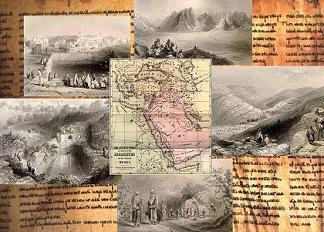
Images from Luther College / Antique Maps and Prints
I believe.
The discovery of the Ebla archive in northern Syria in the 1970s has shown the Biblical writings concerning the Patriarchs to be viable. Documents written on clay tablets from around 2300 B.C. demonstrate that personal and place names in the Patriarchal accounts are genuine. The name "Canaan" was in use in Ebla, a name critics once said was not used at that time and was used incorrectly in the early chapters of the Bible. The word "tehom" ("the deep") in Genesis 1:2 was said to be a late word demonstrating the late writing of the creation story. "Tehom" was part of the vocabulary at Ebla, in use some 800 years before Moses. Ancient customs reflected in the stories of the Patriarchs have also been found in clay tablets from Nuzi and Mari.
The Hittites were once thought to be a Biblical legend, until their capital and records were discovered at Bogazkoy, Turkey. Many thought the Biblical references to Solomon's wealth were greatly exaggerated. Recovered records from the past show that wealth in antiquity was concentrated with the king and Solomon's prosperity was entirely feasible. It was once claimed there was no Assyrian king named Sargon as recorded in Isaiah 20:1, because this name was not known in any other record. Then, Sargon's palace was discovered in Khorsabad, Iraq. The very event mentioned in Isaiah 20, his capture of Ashdod, was recorded on the palace walls. What is more, fragments of a stela memorializing the victory were found at Ashdod itself.
Another king who was in doubt was Belshazzar, king of Babylon, named in Daniel 5. The last king of Babylon was Nabonidus according to recorded history. Tablets were found showing that Belshazzar was Nabonidus' son who served as co-regent in Babylon. Thus, Belshazzar could offer to make Daniel "third highest ruler in the kingdom" (Daniel 5:16) for reading the handwriting on the wall, the highest available position. Here we see the "eye-witness" nature of the Biblical record, as is so often brought out by the discoveries of archaeology.
Higdil Adonai la'asot im eleh.
Higdil Adonai la'asot imanu
Hayinu s'mechim.
The Lord hath done great things for them.
The Lord hath done great things for us;
whereof we are glad.
-- Psalm 126:3
a lot of us think that since the bible is a devotional book, it is partial and metaphorical, unless there is validation from outside sources to confirm the biblical record. my desire to learn more about Y'shua and the bible led me to increase my readings on near eastern archaeology. the discoveries of archaeology since the mid 1800s have demonstrated the reliability and plausibility of the bible narrative. archaeology plays an important part in history, the corroborating evidence that archaeologists present to the world separates fact from fiction. indiana jones (chronicles), though a made-up story, has convinced millions of viewers that the archaeological field connotes fun -- living a life filled with exotic adventures, and romance not far behind (if you find digging for a thousand yr old antiquity romantic... of course, there's also the harrison ford look alike hero who comes to save your ass while bathing around 16-20 ft. nile crocodiles, but that's beside the point).
i'm glad that we have archaeology to back up our beliefs that others would have pointed out as old wives' tales. the discovery of the dead sea scrolls of qumran [copies of books of the hebrew bible, e.g., isaiah, of which two almost complete scrolls have been found; copies of books now collected in the old testament apocrypha and pseudepigrapha, e.g., tobit, 1 enoch, and jubilees; and documents composed by an ascetic community, e.g., a book of community rules called the manual of discipline, an allegorical account of the community called the war of the sons of light with the sons of darkness, a group of devotional poems called the thanksgiving psalms, a commentary on the book of habakkuk, and an extensive work, known as the temple scroll, containing ritual law] for instance, was enough evidence that the bible is legitimate and all too real. what happened to the men of qumran that ultimately led to the discovery of the scrolls, was no accident. things fit together because an intimate, personal God watches over his creation.

 since 2004.10