orchard symphony in red
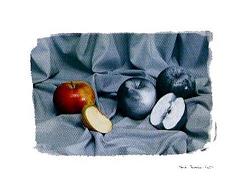 Still Life lV (c) P. Chaban-Raget Still Life lV (c) P. Chaban-Raget
if it's not milkshake, it's cider for me (otherwise, there's good ol' H2O). and since cider day draws near, i'm sharing a brief history of cider and a couple of mouthwatering recipes that can be served over the holidays.
History of Cider
Hard cider became the traditional drink of New England not long after the first settlers arrived.
Then and until recently, "Cider" meant "hard cider". Legally it still does. It was on the table with meals in town houses and farm cottages. Presidents and farm hands drank it. Cider was traded between countryside and town. Orchardists looked for apple varieties suited for cider. The apples were then pressed in the neighborhood, put in casks and brought to the cellar to ferment and age. Our farm neighbors still carry on this tradition.
Cider is a world wide tradition.
In France the traditional cider is light and sparkling and is poured from a champagne bottle. The complex ciders of the Basques and Asturians in Northern Spain come in a corked wine bottle. In England the traditional ciders are kegged like a beer and served on tap at the local pub.
In this country the cider tradition is being renewed. Cider can be found on tap, in six packs, and in wine bottles. Cider is flowing from large scale producers as well as the cellars on New England farms. It is made from generic apple concentrate as well as carefully selected fruit from varieties grown especially for cider. It can provide cool fruity refreshment on a hot afternoon, or complement fine food.
Cider is not wine and it is not beer.
Like wine it is fermented from fruit and can capture the complex flavors of fruit. Like beer, cider has under six or seven percent alcohol and tastes best with some sparkle. It is different from both: a unique beverage. Because of the lower alcohol it is much less intense than wine. To expect the mouth feel of wine when tasting cider ends in disappointment. The smooth taste of grain based beer is contradicted by the aggressive tang of the apple based cider.
What are the characteristics of a good cider?
In Spain, France and England they will tell you with certainty and pour a glass of their local cider to demonstrate. The tastes are wildly different. The only clear guide is that there are different styles and traditions with new ones emerging.
There is the same variety in the making of cider. The scale ranges from an orchardist with a cellar full of barrels to large scale production facilities. The technology ranges from medieval to Victorian to state of the art. Underlying this is the same dictum that winemakers use: it takes good fruit to make good cider. The future in this country is exciting as both orchard-based artisans and large-scale producers experiment with new technique, and orchardists plant traditional and newly developed varieties.
Saturday and Sunday November 6 & 7, 2004
10th Annual Franklin County Apple & Cider Day
Cider Apple Wine
1 gallon fresh pressed cider or apple juice, no preservatives
1 quart water
1 1/2 lbs. sugar or 2 lbs. honey
1 tsp. acid blend (1/2 tsp. if apples are tart)
1/4 tsp. tannin
1 tsp. yeast nutrient
1/2 tsp. pectin enzyme
1 Campden tablet, crushed (optional)
1 packet champagne wine yeast
Put aside 1 quart of the apple juice or cider to drink later. Put the water mixed with the sugar or honey on the stove to boil.
Now pour the hot sugar water over the apple cider. You can do this in a secondary container if you use a funnel and are careful. The cool cider will bring the temperature down quickly. Add the acid, tannin, and yeast nutrient, but wait until the temperature comes down to add the Campden tablet if you choose to. Cover and fit with an air lock. Twelve hours after the Campden tablet, add the pectic enzyme. If you don't use the tablet, then merely wait until the must cools down to add the pectic enzyme.
Check the PA (Potential Alcohol) and write it down. It should be within a reasonable range (10 to 13 percent, depending on how sweet the cider was).
Twenty-four hours later, add the yeast. Stir daily for about two weeks. Check the PA. When it is down to 3 to 4 percent, rack the wine into another glass fermenter.
Rack at least twice during the secondary fermentation. It might take a while to clear. Keep for at least six months. Serve chilled.
from The Joy of Home Winemaking by Terry Garey
Apple Salad with Blue Cheese Croutons and Cider Dressing
2 slices French bread, cubed (about 1 1/2 cups of 1/2-inch cubes)
2 tablespoons olive oil
4 ounces blue cheese
3 tablespoons unsalted butter
1/2 cup walnut pieces
1 tablespoon light brown sugar
1/4 teaspoon Essence, recipe follows
2 medium sweet apples, such as McIntosh or Fuji, cored and thinly sliced, with the peel on
5 tablespoons soft apple cider
1 tablespoon plus 1 1/2 teaspoons apple cider vinegar
1 teaspoon Dijon mustard
1/2 cup canola oil
1 tablespoon minced shallots
1/4 teaspoon salt
Pinch ground black pepper
6 cups mesclun
1/4 pound prosciutto or Serrano ham, thinly sliced then shredded
Preheat the oven to 350 degrees F.
In a bowl, toss the bread with the olive oil. Add 3 tablespoons of the cheese and a pinch of salt and pepper and toss to coat the bread evenly.
Place on a baking sheet and bake until browned, stirring occasionally, 10 to 15 minutes. Remove from the oven.
In a skillet, melt 1 tablespoon of the butter over medium-high heat. Add the walnuts and cook, stirring, until fragrant and lightly toasted, 2 to 3 minutes. Add the sugar and Essence, and cook, stirring, until the sugar is caramelized and the nuts are evenly coated, about 2 minutes. Remove from the pan and spread on a waxedpaper lined plate. Separate with a fork and let cool.
Add the remaining 2 tablespoons of butter to the pan and add the sliced apples. Cook, stirring, until lightly caramelized on both sides, about 5 minutes. Remove from the pan.
In a small bowl, whisk together the apple cider, vinegar, and mustard. Slowly drizzle in the oil, whisking constantly until it emulsifies. Add the shallots, salt, and pepper, and adjust the seasoning, to taste.
In a large bowl, combine the lettuces, prosciutto, and croutons and toss with enough dressing to lightly coat. Adjust the seasoning, to taste. Place the apples in a small bowl and add enough dressing to coat.
Divide the lettuces among 6 salad plates and arrange the apple slices on top. Sprinkle the walnuts and remaining cheese over the apples. Sprinkle with freshly ground black pepper and serve.
Essence (Creole Seasoning)
2 1/2 tablespoons paprika
2 tablespoons salt
2 tablespoons garlic powder
1 tablespoon black pepper
1 tablespoon onion powder
1 tablespoon cayenne pepper
1 tablespoon dried leaf oregano
1 tablespoon dried thyme
Combine all ingredients thoroughly and store in an airtight jar or container.
Yield: about 2/3 cup
Recipe courtesy Emeril Lagasse
All entries and pen and ink drawings are protected under U.S. copyright and other laws and are the property of C. Sophia or the party credited as the provider of the content.
|
|

 since 2004.10